|
|
|
|
P/V
|
This is a continuation of the
Process Intensifier - Optimization with CFD: Part 1 paper.
Power per Unit Volume
A mixing quantity often needed for mass transfer studies
(gas-liquid, liquid-liquid, and solid-liquid) and drop
break-up mechanisms is power per unit volume. P/V of these units can
be determined once the volume of the mixing chamber has been
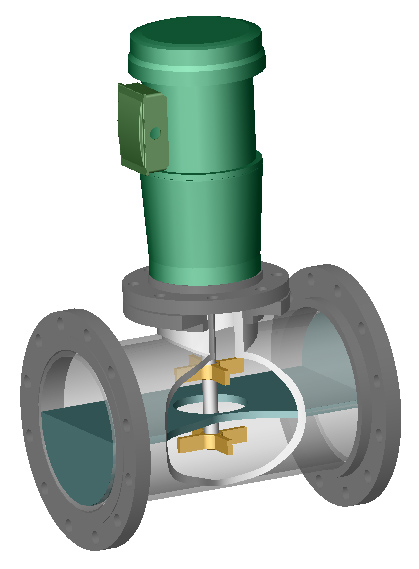
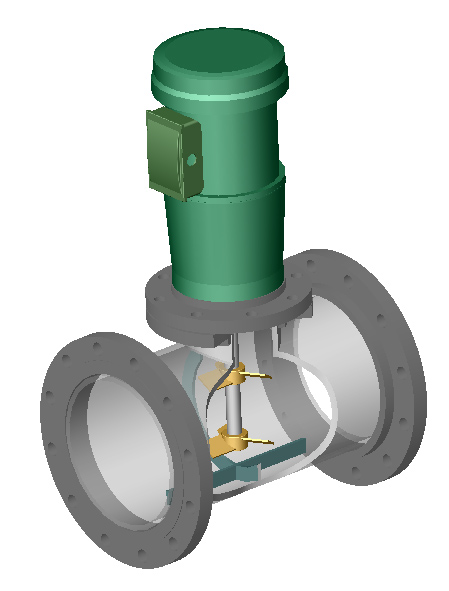
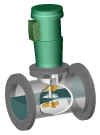
determined. The mixing volume of the radial Process Intensifiers
is defined as the volume in the 10" (254 mm) pipe between
the two Z-plate ends plus the volume of the T. This is 19.7"
(500 mm) for LTR and 7.9" (200 mm) for HGR. For the axial
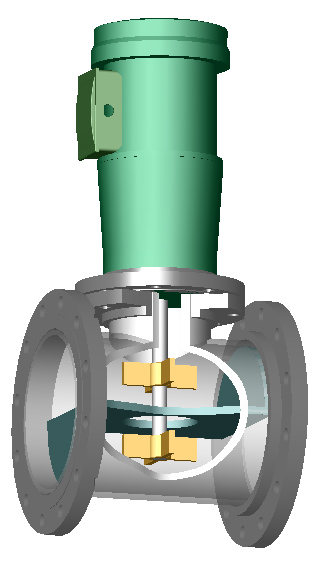
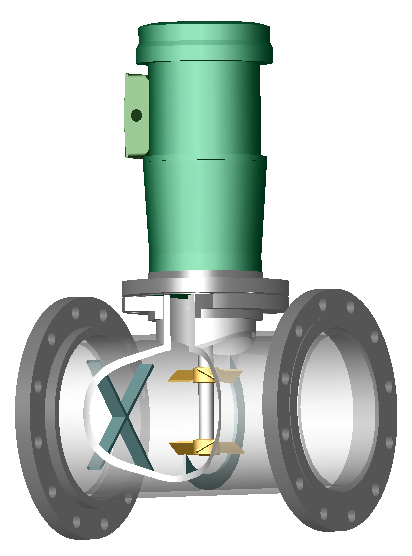
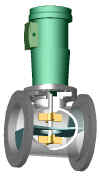
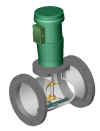
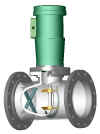
designs, the active mixing volume (as can be seen on Figures
9-11) appears to be about 8" (203 mm) wide. The volume of the
T is 0.42 Gallons (1.58 Liters).
| N=1750 RPM |
Radial Process Intensifiers |
Axial Process Intensifiers |
| |
Lightnin – LTR |
Hayward Gordon – HGR |
Lightnin – LTA |
Hayward Gordon – HGA |
| Click on any picture for a bigger picture |
 |
 |
 |
 |
| Volume: Gallons (Liters) |
7.1 (26.9) |
3.1 (11.7) |
3.1 (11.7) |
3.1 (11.7) |
| 0 GPM |
685 (137) |
2059 (412) |
85 (17) |
438 (88) |
| 650 GPM |
685 (137) |
2059 (412) |
88 (18) |
438 (88) |
| 1100 GPM |
715 (143) |
2339 (468) |
95 (19) |
445 (89) |
Table 3: P/V in HP/1000
Gallons (kW/m3)
at N=1750 RPM and water.
The volume here refers to the active mixing
volume. |
Table 3 shows just how much specific power can be put into a
mixing vessel. Because HGR has a shorter length between the Z-plate
ends its P/V is extremely high. If this were attempted in a
standard stirred tank, the contents of the tank would be flung right
out of the tank. The motor and gearbox would also be much larger
than the vessel. Notice also that HGA has about the same P/V as
LTR using only 40% of the power of LTR. A mixer in a pipe is
an excellent way for putting in high amounts of specific
power effectively into a mixing vessel.
Continue with Pressure Drop
or Go back to Results
or Go back to the Title Page
|
|
|