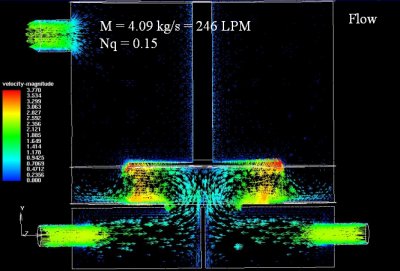
CFD can determine the flow rate and the Nq-value simply
by determining the flow pumped through the inlets and outlet.
In this case, the only thing we determine is the impeller design
and the speed.
|
CFD vertical slice vector plot
Click on the image for a larger and better view.
|
Notice the flow pattern is very pronounced in the inlet and
outlet pipes, in the false bottom, and in the impeller. Everything
else is very quiet, where drop coalescence can and will take place.
Here is just one verification (proof) that the CFD computer
simulation is very good indeed. To the left is data taken
experimentally with a Laser at Lightnin.
The data on the right was derived using the CFD Acusolve program.
There is much more information that can be derived from the CFD.

|
Agreement with LDA measurements
Click on the image for a larger and better view.
|
Unlike other mixing impellers the SX pumper impeller creates head,
like a pump. This can also be determined accurately with a CFD.
 |
Pressure distribution
Click on the image for a larger and better view.
|
This picture shows the pressure distribution. From this we
can determine the actual pumping head of the impeller. We can see
how the fluid is sucked into the false bottom chamber and up to
the pumper.
 |
Acusolve power output
Click on the image for a larger and better view. |
Power and Np are calculated through a routine.
Keith Johnson has proven over and over again that the
calculated power is within ±2% of the actual power draw, even in
a continuous system like SX. Take a look at
other CFD projects we have done.
SX Animation
|



